Contents
2. Procedure and control description
The object Transport (external) receives products (in a material handling equipment) from the previous object and transports them on vehicles/transporters to the following object.
Both the number of transporters and the capacity of each transporter can be defined.
2. Procedure and control description
The object has a receiving buffer for parts in conveyors. This is limited to the capacity (number of conveyors) per transporter.
The Number of parts per conveyor depends on predecessor (supplier: container quantity, process: transfer quantity).
When parts in carriers enter the input buffer, the conveyors are reloaded onto a transporter until either the input buffer is empty or the transporter is full.
Then the transporter is started to the destination (transport duration).
At the delivery destination, a delivery buffer for conveying aids is also integrated internally (analogous to the input buffer in conveying aid capacity per transporter).
Here, the transporter must wait until it has been able to pass all of the to the delivery buffer (capacity e.g. full if the parts cannot be transferred to successors).
Transporters cannot overtake each other at the pickup and delivery point in the model.
If all conveyors have been passed on in one transporter, it can start the return journey (separately from the outward journey) (return journey time).
Process to customer model

Figure 1 - Process to customer model
Supplier to Manufacturer model

Figure 2 - Supplier to Manufacturer model
Supplier Restocking Time
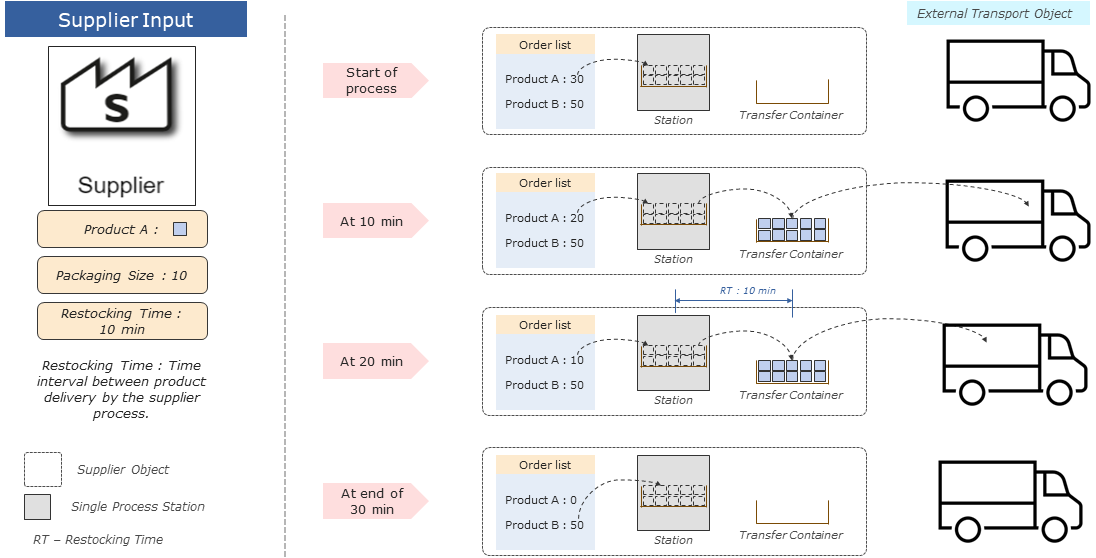
Figure 3 - Supplier Restocking Time
Figure 4 - Transport (external) |
|

See chapter Possible connections to objects.
© SimPlan AG - Hanau District Court, Commercial Register (Part B) 6845 - info@simplan.de - www.simplan.de/en